

Safenet results are informational only. They are not a guarantee, warranty, or financial advice. Safenet does not custody funds or control transaction execution, and false positives and false negatives can occur.
How Safenet governance works
SafeDAO proposals execute through one of two Safenet Governance Safes, depending on the chain and the change: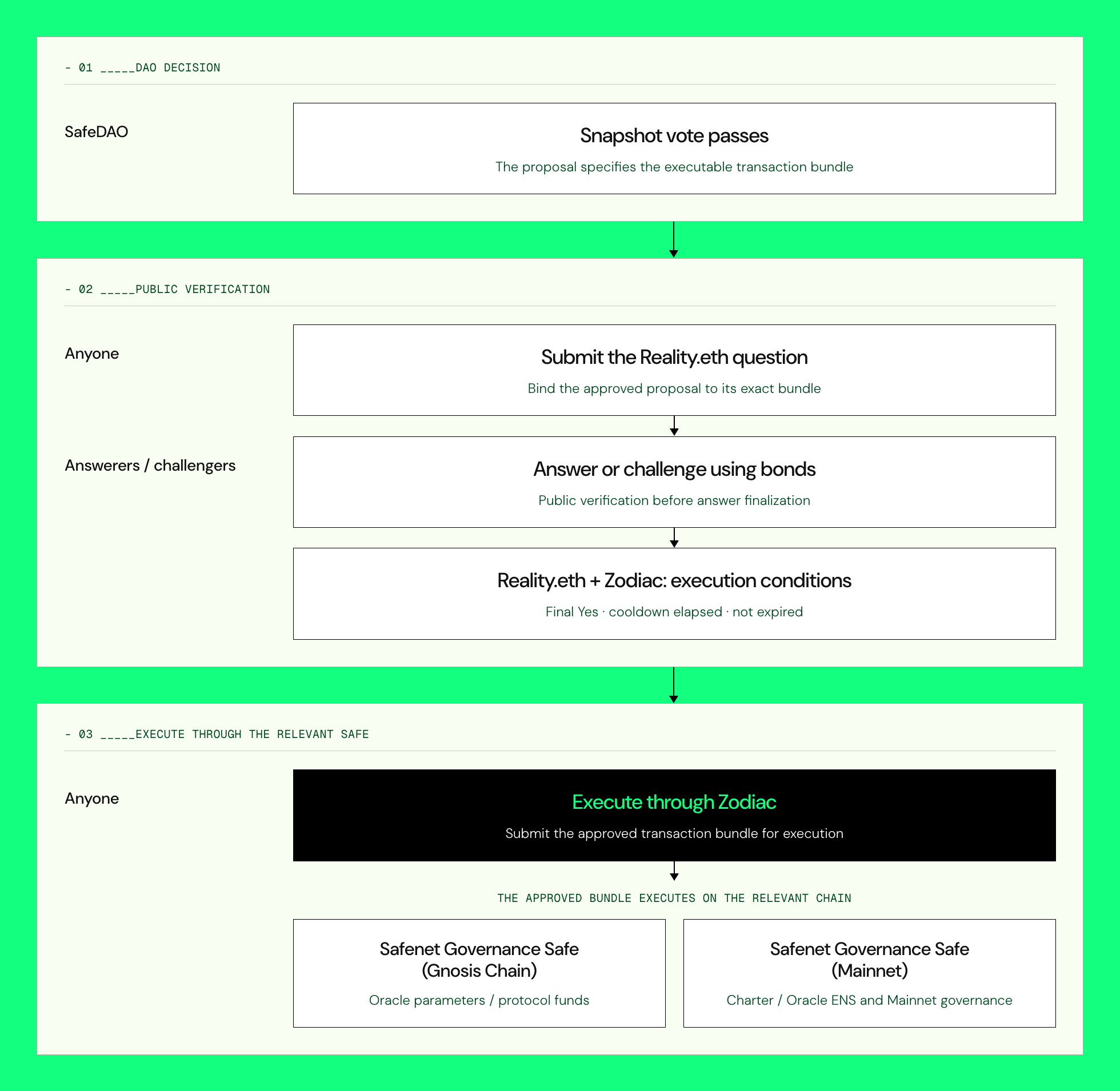
- Oracle parameter governance: is the governance address of the Safenet Oracle and executes approved Oracle parameter changes, such as Sentinel set, fee, and bond changes.
- Protocol funds: receives the SafeDAO fee share and slashed Sentinel bonds.
- Mainnet governance: executes SafeDAO decisions on Ethereum Mainnet.
- Staking governance: owns the Staking contract, which records the active Validator set and the withdrawal delay. Changes are subject to the contract’s configuration delay.
- Canonical references: controls the
charter.safenet-gov.ethandoracle.safenet-gov.ethENS records, which identify the canonical Charter and Oracle. - Rewards distributions: executes accepted Validator and Delegator rewards distributions. This follows a separate process described in Rewards.
How proposals execute
Proposals on both Safes follow the same steps. Every step after the Snapshot vote is permissionless. 1. Snapshot vote A SafeDAO Snapshot proposal passes together with its executable transaction bundle. The bundle is the exact set of transactions the Safe will run if execution is authorized. 2. Reality.eth question Anyone can submit a Reality.eth question for the proposal. The question binds the proposal to the hash of the exact transaction bundle and to the applicable authorization criteria. It asks whether executing that bundle is authorized. A question asked before the Snapshot vote has concluded is answered Invalid. 3. Answers, challenges, and bonds Anyone can answer Yes, No, or Invalid by posting a bond in SAFE. Anyone who disagrees can challenge by posting a different answer with at least double the previous bond. Each new answer restarts the question timeout. The answer that stands when the timeout elapses becomes final. Bonds escalate with each challenge. When an answer is overturned, its bond goes to the participants who gave the final answer. This makes defending a wrong answer increasingly costly, but it does not guarantee a correct answer. The outcome depends on participants who are willing to post bonds to correct a wrong answer in time. No arbitrator is configured, so bond escalation is the only way to dispute an answer. 4. Execution Once all of the following conditions hold, anyone can execute the bundle through the Zodiac Reality Module:- The Reality.eth answer is final and Yes.
- The cooldown after finalization has elapsed.
- The answer has not expired.
- The proposal has not been vetoed.
- No or Invalid: the bundle cannot execute on the basis of that question. Making the change requires a new proposal.
- Veto: the Safe Ecosystem Foundation (SEF) can permanently invalidate a pending proposal, only for tax, sanctions, or AML compliance. This is a usage policy and is not enforced onchain. The veto cannot initiate, approve, or execute transactions. See Veto Module.
- Expiration: if the bundle is not executed before the answer expires, it can no longer execute on the basis of that answer. Making the change requires a new proposal.
Current configuration
The Reality Modules on both Safenet Governance Safes use the following configuration. The onchain module configuration is authoritative if it differs from this page.
Timing
An unchallenged answer becomes final 3 days after it is posted. Each challenge restarts the timeout, so challenges can extend the time to finalization. After finalization, execution waits for the 5-day cooldown. The answer expires 7 days after finalization, which leaves a 2-day execution window after the cooldown ends.
Owners
Each Safenet Governance Safe has a single owner, the inert address
0x0000000000000000000000000000000000000002, with a threshold of 1. This address cannot sign, so no signer can execute transactions from either Safe. Transactions execute only through the Reality Module after the checks above. See Governance accounts.
ENS references
Control of the safenet-gov.eth ENS records has been handed over to the Safenet Governance Safe (Mainnet). Routine Oracle parameter changes go through the Safenet Governance Safe (Gnosis Chain). Changes to the Charter reference and replacement of the Oracle go through ENS governance on Mainnet. See ENS records for each record and its purpose.
What SafeDAO governs
Charter The Safenet Charter defines the rules Sentinels apply when evaluating transactions. The canonical Charter version is referenced throughcharter.safenet-gov.eth.
For convenience, the Charter is also published in the safenet-charter repository.
SafeDAO can adopt a new Charter version and update the canonical reference through governance. A Charter change applies according to the effective time or epoch defined for that version.
Oracle parameters
The Safenet Oracle is deployed on Gnosis Chain. It contains the protocol logic and configuration used for Sentinel participation, fees, bonds, arbitration, and related Safenet mechanics.
SafeDAO can update configurable Oracle parameters without replacing the Oracle contract:
- Sentinel set: Add or remove Sentinels.
- Transaction-check fee: Change the USDC fee charged for a Safenet check.
- SafeDAO fee share: Change the portion of transaction-fee revenue directed to DAO-controlled protocol funds.
- Bond slashing: Change the amount of a Sentinel bond that can be slashed under the applicable rules.
- Protocol funds receiver: Change the address receiving DAO fee revenue and slashed bonds.
- Immutable protocol logic.
- Fixed Sentinel incentive mechanics.
- The Oracle’s Governance address.
- The Safenet Security Council address.
oracle.safenet-gov.eth ENS record on Ethereum Mainnet. The record identifies the canonical Oracle contract on Gnosis Chain and the activation epoch for a new Oracle version.
Validators must adopt the new Oracle configuration for that epoch. Safenet uses a two-week transition period for Validator adoption. At least two-thirds of Validators must adopt the new Oracle version, and Validators that do not update within the transition period lose rewards.
Participant sets
SafeDAO governs the Sentinel and Validator sets. The Sentinel set is configured in the Oracle on Gnosis Chain. The Validator set is recorded in the Staking contract on Ethereum Mainnet.
The initial participant sets are approved through SafeDAO governance. Later additions and removals follow the applicable governance process. See Participant selection for how Sentinels and Validators are proposed, approved, added, and removed.
Participant selection
Review how Sentinels and Validators are selected.
Economics
Review Safenet’s economic and incentive model.
Sentinels
Review the Sentinel role.
Validators
Review the Validator role.